
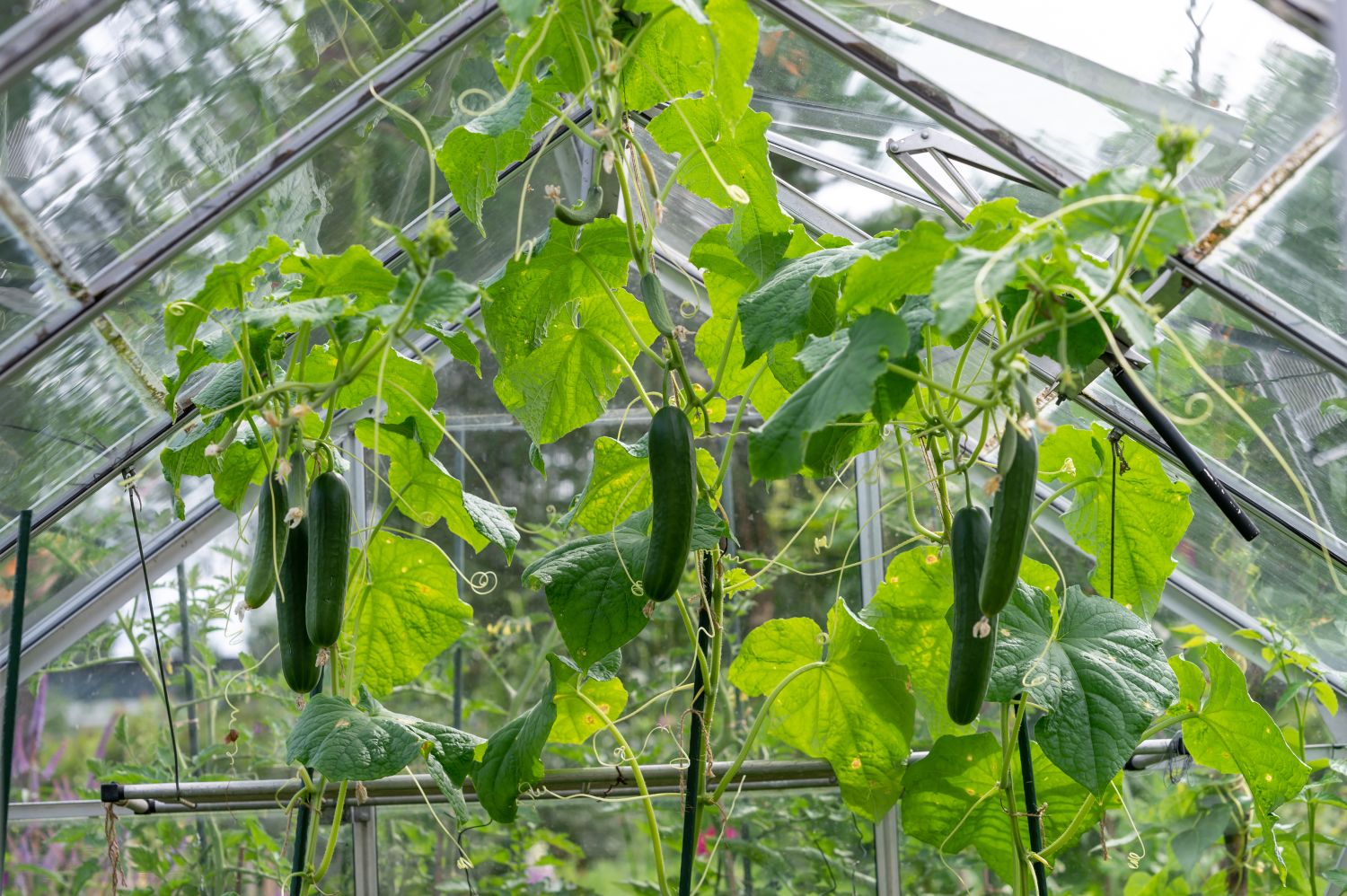
Growing juicy, crisp cucumbers in your own greenhouse is very rewarding. But before you get started, you may be wondering – can you successfully grow cucumbers in a greenhouse environment? The answer is yes, you absolutely can!
In fact, a greenhouse provides the ideal conditions for growing bountiful cucumber crops. The controlled environment allows you to manage factors like temperature, light, and humidity to maximize growth.
You will learn everything you need to know to grow cucumbers in a greenhouse in this in-depth guide.
Why Grow Cucumbers in a Greenhouse?
There are several key reasons why a greenhouse is well-suited for growing cucumbers:
-
Wider variety – A greenhouse allows you to grow a wider variety of cucumber cultivars that need more warmth, including English and Persian types.
-
Higher yields—Growing indoors gives you higher yields than growing outdoors. Each plant will produce more cucumbers.
-
Extend the season – Getting a head start by growing in a greenhouse lets you harvest cucumbers earlier and continue producing later into the fall.
-
Pest protection – A greenhouse shields plants from pests like cucumber beetles that can damage outdoor crops.
-
Disease resistance – The ideal growing conditions make greenhouse cucumbers less prone to diseases.
-
Consistent quality – You’ll get evenly shaped, good-quality cucumbers since the environment can be carefully controlled.
Choosing a Cucumber Variety
When selecting cucumber varieties for the greenhouse, consider the following factors:
-
Plant size: Bushes that are small and bushy do best in small greenhouses. In larger greenhouses, climbing varieties can be trellised vertically.
-
How big and round the fruit is: Mini, pickling, slicing, and English cultivars all have different fruit sizes. Pick based on preferences.
-
Disease resistance – Look for resistance to powdery mildew, cucumber mosaic virus, and other common diseases.
-
Time to maturity – Choose fast-maturing varieties if you want to maximize yields in a short season.
Some top greenhouse cucumber varieties include:
- Corinto – early producer of slender, tender fruits
- Green Fingers – disease-resistant, with crisp texture
- Diva – heavy yields of sweet, seedless mini cucumbers
- Carmen – all-female hybrid, resistant to mildew
Getting Started with Seeds vs. Seedlings
You can start cucumbers from seed directly in the greenhouse or purchase seedlings.
Seeds – Starting from seeds is economical and lets you choose from a wide variety of cultivars. However, it requires more time and attention.
Seedlings – Buying seedlings is quick and easy. Look for stocky, healthy plants without signs of stretching or disease. Avoid root-bound plants.
Preparing the Greenhouse Soil
Cucumbers thrive in fertile, well-drained soil. To prepare greenhouse beds:
-
Loosen soil and mix in 2-3 inches of compost or aged manure a few weeks before planting.
-
Check soil pH – cucumbers prefer a slightly acidic pH between 6.0-6.8. Adjust if needed.
-
Add a balanced organic fertilizer at planting time. Cucumbers are heavy feeders.
-
Create raised beds for better drainage and root development.
-
For container growing, use at least a 10 gallon pot with drainage holes, filled with potting mix.
Planting Cucumbers in the Greenhouse
Once spring temperatures are steadily above 60°F, it’s time to get cucumber seedlings established in the greenhouse.
Seeds – Direct sow seeds 1 inch deep and 6 inches apart in rows 3 feet apart. Thin seedlings.
Transplants – Space transplants 12-24 inches apart in rows 2-3 feet apart. Bury stem up to lowest leaves.
Support – Trellis climbing varieties vertically. Use cages or strings attached to greenhouse structure.
Pollination – Open vents daily for bee pollination. Hand pollination can also be done by transferring pollen.
Watering – Keep soil consistently moist but not waterlogged. Drip irrigation works well. Use mulch to retain moisture.
Caring for Greenhouse Cucumbers
To keep your greenhouse cucumbers thriving:
-
Maintain daytime temperatures of 75-85°F and 60-70°F at night. Cucumbers crave warmth.
-
Prune actively – pinch main shoots after 4-5 leaves. Remove lateral shoots and yellowing leaves.
-
Irrigate 1-2 inches per week. Less humidity reduces disease risk.
-
Fertilize weekly with a balanced liquid fertilizer. Soil should be fertile but not overly rich.
-
Scout for pests like aphids and mites. Control with horticultural oils or insecticidal soap sprays.
-
Monitor for diseases. Improve air circulation and prune affected parts.
Harvesting Cucumbers
-
Begin harvesting when fruits are 6-8 inches long. Check plants daily.
-
Use shears or pruners for a clean cut that doesn’t injure plants. Don’t tug fruits off vines.
-
Pick in the morning when cool for maximum crispness. Handle gently to avoid bruising.
-
Leave 1/4 inch stem attached. Harvests prompts further fruit production.
-
Store freshly picked cucumbers in refrigerator in breathable bag for 1 week.
Enjoy Your Greenhouse-Grown Cucumbers!
With the right greenhouse conditions and care, cucumbers can be grown successfully indoors for high yields. The controlled environment lets you fine-tune humidity, temperature, lighting, and other factors to maximize productivity. Follow this guide to grow your own delicious, fresh cucumbers all season long in a greenhouse!
Popular varieties of cucumbers for the greenhouse
| Name | Description |
|---|---|
| Varietal cucumbers | |
| Pace | 1) sweet early maturing; 2) with bundle ovaries; 3) dense, crunchy without bitterness; 4) average weight – 80 g; 5) universal use. |
| Courage | 1) Dutch, introduced in 1980; 2) harvest from a bush – 25 kg; 3) universal use. |
| Sigurd | 1) strong root system; 2) dark green, densely lumpy; 3) average length up to 13 cm; 4) when planting seedlings, the distance between the bushes should be at least 1.5 m. |
| Serpentine | 1) short lashes with small fruits up to 8 cm; 2) fruiting after 36 days; 3) many ovaries (6-8) on the knot; 4) can be used for preservation. |
| Valaam | 1) super-early – ripens in 35 days; 2) cold-resistant; 3) large lumpy with black spines; 4) does not taste bitter. |
| Hybrids | |
| Courage F1 | 1) fruiting – after 45 days; 2) dark green with light stripes; 3) planting seedlings with a density of 3 bushes per 1 m²; 4) yield from 1 m² – 7-8 kg; 5) universal use. |
| Benefit F1 | 1) fruiting – after 50 days; 2) cucumber length up to 13 cm; 3) dark green with small frequent tubercles; 4) sweet, strong, without bitterness; 5) good for salting. |
| Alekseich F1 | 1) early maturing – after 37 days; 2) bundle ovaries; 3) green medium tuberous; 4) average length – up to 8 cm; 5) yield – 12-15 kg / m²; 6) universal use. |
| Emelya F1 | 1) early maturity – after 40 days; 2) bundle ovaries; 3) the growth of the lashes is not limited; 4) bright green, large tuberous with white thorns; 5) planting seedlings with a density of 3-4 bushes per 1m²; 6) fresh application and conservation. |
| Dynamite F1 | 1) early maturing – after 40 days; 2) tuberous with white spines; 3) average length – 12-15 cm; 4) weight up to 120 g; 5) harvesting – 7 kg / m²; 6) universal use. |
Important! When buying seed, you should carefully read the inscription on the sachet with cucumber seeds – you can often see the entry “Parthenocarpic (self-pollinated)” – this is an incorrect labeling. Parthenocarpic (hybrid) cucumber is marked with F1, and varietal has the name (Marta, Bully, etc. ).
The third stage is preparing the soil for the greenhouse. Cucumbers are very fond of loose and fertile soil that retains moisture, which is very important for cucumbers who like to “drink”. The best soil composition for a greenhouse is:
- sod land – 3 parts;
- humus or matured compost – 2 parts;
- sand – 1 part.
Before planting cucumber seeds or seedlings, make the soil more loose by adding 1 liter of vermiculite, 1 glass of ash, and 2 tablespoons of superphosphate.
It is important to know! When changing the soil in a greenhouse for cucumbers, it is necessary to take the soil on which onions, peppers, carrots, potatoes and cabbage were grown, that is, those crops that do not have the same types of diseases as cucumbers.
The fourth stage is the preparation of seeds for sowing when choosing this method of planting cucumbers or growing seedlings.
When sowing with seeds. To get the seeds ready, heat them up to 30 ° C and treat them with a fungicide like Thiram. Then, put the seeds in a gauze bag and soak them in the solution for 15 minutes. Finally, rinse the seeds under running water.
Disadvantages of seed planting of cucumbers in a greenhouse:
- longer vegetative period;
- less yield due to longer growing season;
- 30% of seeds may not sprout;
- a high risk of freezing plantings when frost returns;
- needs more care, like constant air flow, shade for seedlings, and keeping an eye on the soil and air temperatures.
To reduce the risks when planting with seeds, you must:
- Use a polycarbonate cover on your greenhouse because it heats up faster and keeps heat in well.
- use additional heating in the greenhouse (except for the sun);
- choose early varieties of cucumbers to shorten the growing season;
- Plant two seeds in the hole; later, cut off the weaker sprout.
Agronomists give the following recommendations for planting cucumbers by seeds:
- Before planting, the temperature should be at least 12–13 ° C, even at night. Once the first leaves appear, it should be at least 15 ° C all the time. At a lower temperature, the seeds will die;.
- Sowing with seeds should be done in the middle lane from April 20 to May 10;
- do not allow planting density – this will reduce yield;
- The beds should be 30 cm high and planted in two rows, 50 cm apart. There should be at least 90 cm of space between each bed.
- Place the seed flat in a well that has been filled with water up to 2 cm deep. Then, fill the hole with earth up to the level of the bed.
- Cover the beds with cut-up plastic bottles, and take them off every day to let them air out.
- keep an eye on the temperatures of the soil and air all the time.
In the future, the plantings are looked after in the same way as when planting seedlings.
Growing seedlings. For sowing, take separate cups for the correct formation of the root system. The seeds must be germinated before planting in the hole, which in turn must be spilled with a weak solution of potassium permanganate. Sprinkle the seed with a two-centimeter layer of earth.
Cover the cups with polyethylene for 2-4 days until sprouts appear.
If there are three or four leaves on the young cucumbers when you plant them, you will get a good crop.
The fifth stage is planting seedlings. Plant the seedlings in the greenhouse when the soil temperature reaches + 15 ° С. Seedling planting rules:
- The size of the cucumber rhizome should be used to make a depression in the hole with fertilizer.
- deepen the seedlings to the first leaf;
- Watch how far apart the seedlings are—at least 50 cm, and up to 1 m depending on the type. 5 m;.
- compact the soil around the seedlings.
To speed up the production of the first ovaries, special care is required for young cucumber shoots in the greenhouse.
Preparing for growing cucumbers in a greenhouse
How to grow cucumbers in a greenhouse? The preparatory work for starting the cultivation of cucumbers in the greenhouse can be broken down into steps or steps that must be taken to effectively cultivate cucumbers with a bountiful harvest all year round.
The first stage is the choice of equipment. Which is better: a greenhouse or a greenhouse, what are their differences? It should be noted here that cucumbers can be grown year-round in the Central, South and Volga regions, as well as under unfavorable climatic conditions using greenhouse buildings.
There are two types of buildings designed to increase yields and extend the cultivation period:
- A greenhouse is a simpler building, small in size, 1-1. 5 m tall, getting warm from the sun and the heat from the decomposition of manure and humus The greenhouse doesn’t have any doors; to get to the plants, you usually just have to fold the film over from the top or side. It is a good idea to grow cucumbers in a greenhouse because greenhouses are usually used to plant seedlings before moving them to the ground so they get stronger or to germinate seeds. The air in the greenhouse heats up quickly, which is good for plants where they are still growing.
- In agriculture, a greenhouse is a frame structure that protects the soil and keeps heat in. When growing cucumbers in a greenhouse, the ideal height is 2 5 m. The greenhouse can be as tall as it needs to be, as long as it serves its purpose. So, a rather small greenhouse is enough for summer cottages where people want to grow cucumbers for their own use. On the other hand, a larger greenhouse is needed for business sales so that farm equipment can be moved around freely. The frame can be made of metal or wood, depending on what kind of coating it needs to stand up to.
There are three types of greenhouse cover:
- Polycarbonate is strong and light, but it doesn’t keep heat in well enough in the winter. In the winter, greenhouses with this kind of coating need to have extra heating systems, like gas, electric, or wood stoves.
- Because glass is heavy, it needs a metal frame. Glass covered greenhouses can be used all year round.
- The thinnest material is film, and its frame can be made of wire or wood. This kind of greenhouse cover is mostly found in summer cottages where it is used for growing plants and harvesting early.
So, taking into account the requirements for obtaining a crop (for business or home use) and climatic conditions, it is necessary to choose equipment where cucumbers will grow.
The second stage is choosing a variety of cucumbers.In indoor conditions, self-pollinated cucumbers and hybrids (parthenocarpic) are suitable for growing. Varietal cucumber can be planted from year to year by harvesting the seeds yourself. Hybrids are seedless species or containing empty seeds without an embryo. The hybrids are marked F1 when purchased. The main advantages of hybrids are:
- high acclimatization;
- high resistance to pests and diseases;
- faster ripening times;
- the yield is 30-40% higher;
- transportability.
On a note! There is a huge variety of cucumber hybrids with different characteristics, so when choosing, you should carefully read the annotation.
Why You SHOULD Be Growing Cucumbers In A Greenhouse!
FAQ
What is the best way to grow cucumbers in a greenhouse?
In order to get the best results from growing them in this environment, we recommend you follow these top tips:Set up for sunlight. Remove male flowers. Choose an effective training method. Water moderately. Keep pests at bay. Ensure you have good soil conditions.
Can a greenhouse be too hot for cucumbers?
Cucumber Plants – Another popular greenhouse crop, cucumber plants produce the tastiest crops when growing in temperatures from 21 to 28 degrees Celsius / 69 to 82 degrees Fahrenheit.
Can I grow tomatoes and cucumbers in the same greenhouse?
It is not advisable to have cucumbers and tomatoes in the same place every year because they are susceptible to almost the same pests and diseases. There are many companion plants for tomatoes such as oregano, basil, etc. I recommend reading this article by agronomist Henry Morgan.
Do you need to pollinate cucumbers in a greenhouse?
There are two main varieties of cucumber: greenhouse and outdoor. Greenhouse cucumber plants produce long, smooth fruits, much like the ones you find in the supermarket. These plants don’t need to be pollinated. In fact, you should get rid of any male flowers so that they don’t pollinate, or the fruits will be bitter.
How to grow cucumbers in a greenhouse?
To grow cucumbers in a greenhouse, you will need to provide them with plenty of water and nutrients. You can use stakes or trellises to keep the plants standing straight and stop the fruit from making them bend or break.
Which cucumbers are best for a greenhouse?
With thin skins and a mild flavor, they’re perfect for fresh snacking and salads. Miniature or Pickling Cucumbers: Compact and prolific, these cucumbers are excellent for greenhouse spaces. They’re ideal for pickling enthusiasts or anyone looking to maximize space without compromising on yield.
How many cucumbers can a greenhouse plant produce?
The number of cucumbers a healthy plant can produce varies a lot depending on the type, how it is cared for, and the conditions in which it grows. However, on average, a healthy plant can produce 5 to 10 cucumbers. How do you prevent powdery mildew on greenhouse cucumbers? To prevent powdery mildew, maintain good air circulation, reduce leaf wetness, and keep the foliage dry.