
Evergreen shrubs with purple flowers can add an exotic pop of color to your yard or garden year-round. Unlike deciduous shrubs that lose their leaves in winter, evergreens maintain their foliage all year, providing unique texture and interest even when it’s cold and gray outside.
Purple is an eye-catching yet elegant color that pairs well with other shades in your garden. It can act as a focal point, contrasting beautifully with green foliage. The good news is many popular evergreen shrubs produce purple blooms or purplish-hued leaves, giving you lots of options to choose from.
We’ll talk about some of the best purple evergreen shrubs and give you ideas on how to use them in your yard in this article.
Why Choose an Evergreen Shrub with Purple Flowers
If you want to make your garden look better, use evergreens with purple flowers or leaves.
-
Year-round color and interest: Evergreen shrubs maintain their leaves through winter, so purple varieties add striking color when most other plants are dormant. The dark hues stand out against winter backdrops.
-
Long-lasting flowers: Many everblooming purple shrubs produce flowers over an extended period, sometimes from spring to fall. This provides months of color compared to spring-blooming shrubs.
-
Unique texture: Shrubs with purple evergreen leaves add interesting texture and depth to the landscape when paired with plants that lose their leaves in the winter.
-
Less upkeep: Evergreens don’t need as much pruning every year as deciduous shrubs. Their dense branching also helps suppress weeds.
-
Attract pollinators Vibrant purple blooms attract bees butterflies and hummingbirds, bringing more wildlife to your garden.
-
Dramatic focal point: A purple evergreen shrub makes an excellent focal point, especially when planted against a neutral backdrop. The eye is naturally drawn to deep, saturated hues.
10 Top Purple Evergreen Shrubs
Many evergreen shrubs produce purple flowers or have purplish-tinted leaves. Here are some of the most popular options:
1. Loropetalum
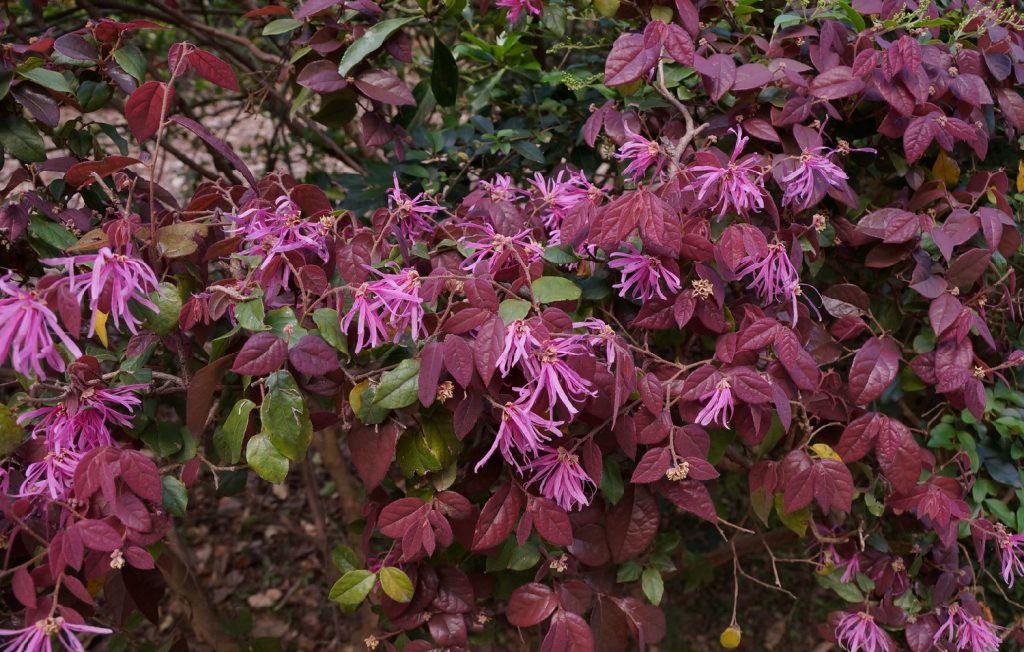
Loropetalum is arguably the quintessential purple evergreen shrub. The most common variety, Loropetalum chinense, comes in purple-leaf forms like ‘Ruby’ and ‘Plum Delight’ with pink spring flowers. Dwarf varieties such as ‘Purple Pixie’ and ‘Purple Daydream’ work well in containers. Give loropetalum shrubs full sun to partial shade.
2. Fringe Flower
Fringe flower (Chionanthus virginicus) is a medium-sized evergreen shrub with delicate, fragrant white spring blooms. However, it’s the foliage that makes it special – emerging deep purple before maturing to lustrous green. ‘Razzleberri’ is a compact cultivar. Grow fringe flowers in full sun to partial shade.
3. Smoke Bush
Smoke bush (Cotinus coggygria) is prized for its airy purple flower plumes that give the shrub a hazy, smoky appearance in summer. It also has striking dark purple foliage. For small spaces, choose the dwarf cultivar ‘Royal Purple’ or ‘Lilla.’ Give smoke bushes full sun for best color.
4. Nandina
Nandina (Nandina domestica) is a bamboo-like shrub with lacy purple foliage and clusters of small white flowers. New growth emerges rich red-purple before maturing to green. Dwarf cultivars like ‘Harbour Dwarf’ and ‘Firepower’ work well in containers. Grow nandinas in full sun to partial shade.
5. Barberry
Barberry (Berberis) is a spiny evergreen shrub valued for its colorful foliage. Purple leaf barberry cultivars such as B. thunbergii ‘Rose Glow’ and B. julianae provide unique purple and burgundy leaves. Give barberries full sun for optimal leaf color.
6. Yucca
Yucca is an architectural, spiky evergreen perennial that blooms with tall spikes of bell-shaped purple flowers. Smaller species like Yucca filamentosa ‘Color Guard’ and Yucca gloriosa ‘Blue Yucca’ work well in gardens. Plant yucca in full sun and well-drained soil.
7. Ceanothus
California lilac or ceanothus offer vivid displays of small purple flowers on low mounding shrubs. C. impressus ‘Victoria’ and C. x ‘Concha’ are two evergreen varieties that bloom in spring with royal blue flowers. Give these West Coast natives full sun and little summer watering.
8. Hebe
Hebe is a compact New Zealand native valued for its colorful evergreen foliage and pretty spikes of tubular purple flowers in summer. Good evergreen choices include H. albicans and H. pinguifolia ‘Pagei.’ Grow hebes in full sun with moderate water.
9. Rosemary
Rosemary is a culinary herb that doubles as a nice evergreen shrub, especially in mild climates. Upright varieties like ‘Tuscan Blue’ produce light purple flowers alongside gray-green aromatic foliage. Give rosemary full sun and light irrigation. Trim plants after flowering.
10. Cistus
Also called rockrose, cistus offer papery, crepe-like purple blooms on low-growing evergreen shrubs. Two standouts are Cistus x purpureus and Cistus x argenteus ‘Striatus.’ Cistus need full sun and prefer sandy, well-drained soils.
Design Tips for Evergreen Shrubs with Purple Flowers
When incorporating purple evergreens into your landscape, keep these design principles in mind:
-
Use purple shrubs as focal points or accents against backdrops like evergreen hedges, neutral walls, or green lawns.
-
Complement purple foliage with perennials like salvia, lavender, catmint, or ornamental grasses.
-
Try combining lighter and darker purple shrubs for visual interest. For example, plant a deep purple smoke bush near paler purple Texas sage.
-
Repeat purple shrubs in odd numbers for bolder impact, such as three fringe flowers in a row.
-
Situate purple shrubs where their rich hues can be viewed from inside the home, such as near windows or patios.
-
Prune overgrown purple evergreens to renew their shape and keep their coloring vibrant. Remove dead or diseased branches promptly.
-
Amend soil with compost or organic matter to help purple shrubs establish. Mulch around plants to conserve moisture.
With proper siting and care, evergreen shrubs with purple blooms or leaves can provide striking, low-maintenance color in your garden year-round. They beautifully brighten dreary winter landscapes. Choose varieties suited to your climate and site conditions for the best results. Then enjoy their dazzling hues and textures.
What kind of bushes stay green all year?
The two basic types of evergreen shrubs are conifers, which have needles, and broadleaf evergreens, which produce leaves.
What are the most popular evergreen shrubs?
Some of the most common evergreen shrubs include arborvitae, boxwood, false cypress, holly, juniper, wintercreeper, azalea and rhododendron.
Best Shrubs With Purple Flowers ️
FAQ
What shrub has purple flowers?
Several shrubs offer beautiful purple flowers. Popular options include the Lilac (Syringa vulgaris) known for its fragrant, branching clusters. Other choices include the Butterfly Bush (Buddleja davidii) with its long, cone-shaped flower clusters, and the Bluebeard (Caryopteris), which blooms with a haze of blue-purple flowers in late summer and fall. Rhododendrons also offer a variety of purple shades, including lavender-purple.
What evergreen climbing plant has purple flowers?
Solanum crispum Glasnevin is a beautiful evergreen climber that has a lot of rich purple-blue flowers with a yellow center in the summer. On sandy soils, the flowers may be a little paler blue. It is a strong grower which benefits from being allowed to grow rather than being contained by pruning.
What is the invasive ground cover with purple flowers?
Ajuga. This pretty purple plant, also known as carpetweed or bugleweed, is a popular groundcover that has the ability to suppress other weeds. The plant quickly spreads by sending out horizontal roots, though, which makes many gardeners dislike it once it takes over their lawn or backyard garden.
What is a purple star shaped flower shrub?
Shooting Star (Pseuderanthemum laxiflorum): If you can find it, shoot star is a flowering shrub that doesn’t get enough attention. People love it because it has shiny green leaves and purple flowers that look like stars from mid-spring to early winter.