
As cannabis laws relax across North America, more people are growing their own marijuana plants. But identifying cannabis isn’t always easy, especially for novice gardeners Many common flowers closely resemble weed in shape, color, or scent. Misidentifying these lookalikes could lead to legal trouble or accidental poisoning So it’s crucial to properly differentiate harmless flowering plants from potent cannabis.
Here are 7 innocent flower plants that are frequently mistaken for marijuana
1. Coral Plant
The coral plant has green leaves that look a lot like cannabis. The leaves are hand-shaped and have 5–7 lobes. This subtropical plant comes from South America but is grown as an ornamental plant all over the world. Tiny white coral-like blooms emerge in summer. But take a whiff—coral plant leaves have a funky, rubbery smell instead of marijuana’s earthy smell, so you can tell them apart right away.
2. Japanese Maple
The delicate, hand-shaped leaves of Japanese maple could easily be mistaken for marijuana at first glance But maples are small flowering trees, not herbaceous like cannabis. And the leaves flush dramatically crimson in fall – a sure giveaway that it isn’t weed! Still, Japanese maple’s invasive tendencies allow it to stealthily blend into cannabis patches
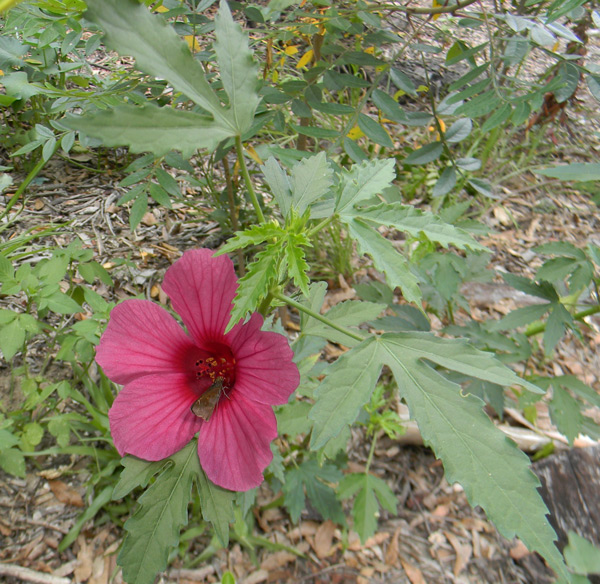
3. Cranberry Hibiscus
This tall, bushy plant has leaves that look like maple leaves and are divided into 5 to 7 pointed lobes. But cranberry hibiscus lacks weed’s telltale serrated edges. By late summer, it bursts into bright pink, white, or red flowers, unlike the small, unnoticeable cannabis flowers. It’s a beautiful and legal garden focal point.
4. Oregano
When dried, aromatic oregano strongly resembles dried marijuana buds. Key differences can be seen upon close examination, such as the oregano plant’s pointed leaves and clumped flowers. The earthy oregano smell, on the other hand, might make new sniffers think they’ve found a good stash.
5. Cassava
Cassava foliage looks like a dead ringer for weed. The tropical plant has big, hand-shaped leaves that end in five to seven long points. But cassava stems don’t have the red hairs that cannabis stems do, and the plant grows over 6 feet tall, which is a lot taller than a typical pot plant. People eat cassava root all the time, but unlike marijuana, its leaves are poisonous.
6. Sweetfern
This unassuming deciduous shrub emits an uncanny cannabis smell. Its foliage also resembles marijuana at first glance. But sweetfern’s clustered leaf arrangement and lack of flowers or buds proves it’s an imposter. An experienced eye can quickly tell the difference between this common woodland plant and a cultivated pot crop.
7. Kenaf
In the vegetative stage, kenaf closely resembles cannabis with its characteristic hand-shaped, lobed leaves. But by flowering, vivid yellow hibiscus-like blooms emerge, revealing its true identity. Also, kenaf’s leaves attach differently along the stems than marijuana. Still, kenaf is often mistakenly destroyed by overzealous cannabis “eradication” efforts.
Properly differentiating harmless ornamental plants from illicit cannabis prevents dangerous legal mix-ups. Subtle features like leaf arrangement, flowers, fragrance, and growth habit separate imposters from the real thing. When in doubt, consult an expert before accusing your neighbor’s garden of harboring contraband! With closer inspection, most landscape marijuana lookalikes turn out to be 100% lawful after all.
How to tell the difference?
People often mix up weeds and nice plants because their flowers look the same, bloom at the same time, or bloom in the same color. A closer look usually fleshes out the difference.
For example, a weed flower might be a little different in shape from a wildflower that looks like it, or it might have a different number of petals, or the flowers on the stems might be set up in a different way. Sometimes the flowers are so different they immediately set apart plants that look nearly identical in habit and leaf. Just be sure to eliminate a weed before its seeds have a chance to mature and drop.
A second identifier is plant leaves. One plant may have larger, wider leaves while the other may have narrower or even needle-like foliage. Or, one plant’s stems might have leaves that face each other, while the other plant’s stems might have leaves that go up and down in a different order. Or one plant’s leaf edges might be smooth while the other’s might be “toothy” or jagged.
Other determining clues include the plant’s growth habit (spreading, bushy, upright), where the plant is growing (sun vs. shade, wet vs. dry, disturbed vs. undisturbed soil), how fast or aggressively a plant is growing, and what the plant looks like underground (roots, runners, or bulblets).
Here are six common spring weeds and how to tell them apart from similar native plants:
Creeping charlie (Glechoma hederacea) vs. golden ragwort (Packera aurea). These two ground-huggers have similar heart-shaped foliage, but the flowers quickly differentiate them.
The weedy creeping charlie produces close-to-the-stem lavender flowers while the native golden ragwort produces golden daisy-like flowers.
Creeping charlie also has scalloped leaf edges and a mint-like odor when crushed, while golden ragwort’s leaves are toothed.
Lesser celandine (Ranunculus ficaria) vs. marsh marigold (Caltha palustris). Both of these flower yellow in early spring, grow in moist habitats, and have similar heart-shaped leaves.
The tell-tale difference is that when you dig up lesser celandine (an invasive in more than 20 U.S. states) you’ll find cream-colored bulblets and roots with finger-like tubers. Native marsh marigolds have no bulblets and fibrous roots.
Lesser celandine also is sometimes confused with native wood poppies. The distinction is the yellowish-orange sap that comes out of wood-poppy stems.
Garlic mustard (Alliaria petiolata) vs. cut-leaved toothwort (Cardamine concatenata). Both of these produce clusters of small white flowers in spring. A key difference is that the weedy garlic mustard has triangular, wrinkled leaves and a garlic odor when its leaves are crushed. Native cut-leaved toothwort has narrower leaves and no garlic odor.
Giant hogweed (Heracleum mantegazzianum) vs. cow parsnip (Heracleum maximum). These are both large, toothy-leafed members of the carrot family that produce umbrella-like clusters of white flowers in mid to late spring. The weedy and rash-causing giant hogweed has distinctive purple spots on its stems (native cow parsnip does not), the plant is much larger overall and its flower clusters are fuller and bigger than cow parsnip. Giant hogweed can grow to 14 feet tall and its leaves can span five feet with lobes that are deeply incised. Cow parsnip grows to about 7 feet and its leaves are half the size of giant hogweed with more rounded lobes.
Giant hogweed is a hazardous, federally listed noxious weed. Its sap contains phototoxic chemicals. If the sap comes into contact with your skin and then is exposed to sunlight, it can cause severe skin irritation including painful, burning blisters and long-lasting scars. If the plant touches your skin, immediately wash the area with soap and water and protect from sunlight for 48 hours. This plant can also displace native plants. Native cow parsnip is less toxic, but it can still cause a rash or burn. Use caution around either plant.
Star of Bethlehem (Ornithogalum umbellatum) vs. wood anemone (Anemone quinquefolia). Both of these produce star-shaped white flowers in early to mid-spring. A key difference is that the weedy star of Bethlehem has narrow, grass-like foliage while native wood anemones have wider leaves with toothy edges.
Creeping speedwell (Veronica filiformis) vs. woodland phlox (Phlox divaricata). Both of these are short, spreading perennials with blue flowers in April and May. The difference is that weedy creeping speedwell has a creeping habit with rounded leaves that alternate up its stems, while the native woodland phlox (also known as creeping phlox and blue phlox) grows in a clump-like habit and has narrower leaves that are opposite one another on the stems.
Read how to control and prevent different kinds of weeds.
Weed or Wildflower? Spring Weeds that Look Like Native Plants
Not everything that pops up in the yard is a weed. Native wildflowers and other desired plants also can readily spread and sprout. And since some of them look like common weeds, it’s important to know the difference before you automatically eliminate them.
Killing native look-alikes by mistaking them for weeds can be detrimental to the ecosystem. Some native plants provide pollen for dwindling pollinator populations, some of them provide food for caterpillars of native butterflies, and some of them serve as natural (and free) soil coverings that prevent erosion.
Eliminating the wrong plants also is a waste of time, money, and effort as well as an unnecessary use of herbicides.
This is what a Flowering Cannabis Plant Looks Like.
FAQ
What flowering plant looks like weed?
The Texas Star hibiscus, also known as the scarlet rosemallow, is a native of the Americas and a popular ornamental plant. During its growing phase (before it blossoms), the Texas Star looks deceptively like weed.
What plant looks like weed but is not?
Coral Plant – Native to the Americas and the Caribbean, the coral plant is a striking garden ornamental plant that looks like cannabis. It also has lobed leaves reminiscent of marijuana’s leaf contour.
Does Cleome plant look like weed?
I’ve grown Cleomes in my gardens for years now and always get a kick out of visitors who see these big plants in our yard. They stop, take a second look and look at us inquisitively. The leaves look like marijuana leaves, and the tall stems that hold the flowers give off a strong-smelling, sticky oil.
How can I tell if it’s a weed or a plant?
If you’re not sure if a plant is a weed or an ornamental, try to pull it out. If it’s impossible to uproot, it’s a weed. If it comes out of the ground really easily, it is (was) a valuable ornamental.
What flowers look like weed?
But before reporting a false claim to the police, you simply need to look at its flowers which appear pink, rose, purple, and white: more showy and elaborate than an actual weed. Coral Plant – Native to the Americas and the Caribbean, the coral plant is a striking garden ornamental plant that looks like cannabis.
Do plants look like weeds?
Plants that look like weeds are deceiving by their looks. Imagine taking a short walk in a natural park and coming across seven-pointed leaves that look like marijuana. Our dear friend, let us tell you, it’s not marijuana.
What flowers have similar leaf morphology and flowers?
Most of the time, the leaves and flowers of these plants look alike: Spider Plant: This plant is in the caper family and has one or two-colored flowers. Its leaves are pointing and look a lot like pot plants. But before calling the police on a false claim, all you have to do is look at its flowers, which are pink, rose, purple, and white.
Which flowering plants get mistaken for marijuana?
Here are some of the most common flowering plants that get mistaken for being marijuana: This wildly popular ornamental tree has leaves uncannily similar to pot. The iconic five-fingered leaf with serrated edges could fool anyone. But the leaves connect at the base rather than growing separately on branching stems.
What do marijuana leaves look like?
Depending on the strain and growing conditions, marijuana leaves can vary in color from vibrant green to deep purple, and sometimes even shades of red or orange. They’re also known for their resinous coating, which contains the cannabinoids and terpenes responsible for the plant’s effects and aroma.
What weed plant looks like a fern?
Two hibiscus species, cranberry and scarlet hibiscus, are included in the list of plants that resemble weeds due to the finger-shaped foliage. However, it can be differentiated by the color and, of course, the characteristics of inflorescence.